| ISBN: | 9780439262408 |
| Publisher: | Cartwheel Books |
| Published: | 1 March, 2001 |
| Format: | Hardcover |
| Language: | English |
| Links | Australian Libraries (Trove) |
| Editions: |
7 other editions
of this product
|
- Old Macdonald Had a Farm
- The Wheels on the Bus
- Ten little monkeys
- There Was an Old Lady Who Swallowed a Fly
- Down by the Station
- Here We Go Round the Mulberry Bush
- Five Little Ducks (Raffi Songs to Read)
- Down in the Jungle
- Cows in the Kitchen
- Five Little Men in a Flying Saucer
- Ten Fat Sausages
- Dry Bones
- Down in the Jungle
- Wheels on the Bus
- One Elephant Went Out to Play
- The Ants Go Marching
- I Am the Music Man
- Down by the Station (Classic Books with Holes)
- Twinkle, Twinkle Little Star (Classic Books With Holes)
- There Was an Old Lady Who Swallowed a Fly (Books With Holes Ser.-French Version)
- Itsy Bitsy Spider
- Itsy Bitsy Spider
- Little Miss Muffet
- Five Enormous Dinosaurs (Classic Books with Holes Board Book)
- Mary Had a Little Lamb







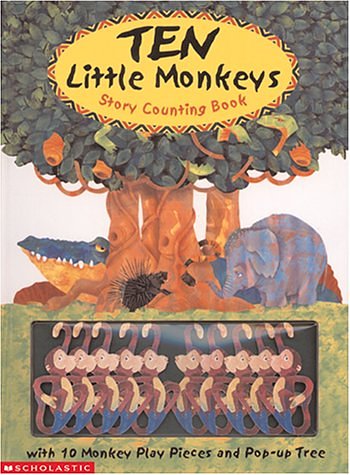
Ten little monkeys swinging on a vine are quickly reduced to nine when one finds a water hole (headfirst!), then eight when they play out till late (and one meets a crocodile), then seven, six, five, all the way down to one in this bouncy, whimsical counting book. The most intriguing element in the big tall book is the giant pop-up tree that remains upright throughout the story. Readers hang 10 paper monkeys (provided inside a clear plastic window on the cover) from vines on the tree, then remove them one by one as each meets his or her jungle fate. The lurking perils include a sleeping tiger, a prickly bush, a large, green snake, and an easily annoyed elephant. But are these nine calamity-prone primates really gone for good, or will the last remaining one swing again with his playmates? Jonathan Lambert's visible brush strokes and bright colors are reminiscent of Eric Carle's illustrations (Brown Bear, Brown Bear, What Do You See?), with silhouetted backgrounds to tell their own part of the story. The paper monkeys and pop-up tree are not sturdy enough to withstand a lifetime of abuse, but they should stand strong long enough to get readers off to a great start in counting. (Ages 3 to 6) --Emilie Coulter