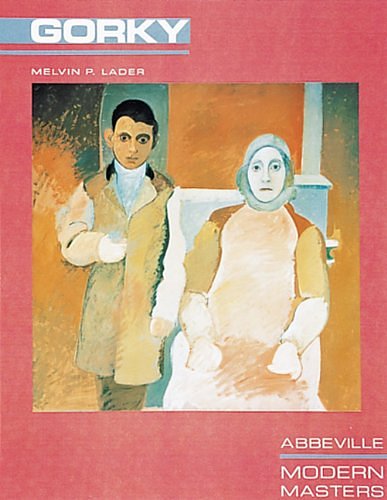
Arshile Gorky (Modern Masters)
Reconsidering the History of American Abolitionism
World of Art #8Lader M
| ISBN: | 9781558592490 |
| Publisher: | Abbeville Press Inc.,U.S. |
| Published: | 1 July, 1985 |
| Format: | Paperback |
| Language: | English |
| Editions: |
2 other editions
of this product
|
- 1 Coming of the Third Reich
- 1 The Coming of the Third Reich
- 2 The Third Reich in Power, 1933-1939
- 2 Willem De Kooning
- 3 The Third Reich at War
- 3 Jackson, Pollock
- 3 The Third Reich at War
- 3 Malory Towers 03 Third YearMalory Towers
- 4 Andy Warhol (Modern Masters Series, Vol. 4)
- 5 George Segal
- 6 David Smith
- 7 Jasper Johns (Modern Masters Series, Vol. 7)
- 8 Arshile Gorky (Modern Masters)
- 9 Francis Bacon (Modern Masters Series, Vol. 9)
- 10 Hans Hofmann
- 11 Philip Guston
- 12 Constantin Brancusi
- 13 Marc Quinn: Chemical Life Support
- 14 Georges Braque
- 15 Lee Krasner
- 16 Isamu Noguchi,
- 18 Jim Dine
- 19 Max Beckmann
- Modern architecture
- Conceptual Art



Arshile Gorky (Modern Masters)
Reconsidering the History of American Abolitionism
World of Art #8Lader M
Even now, some forty-five years after his death, the works created by Max Beckmann exert an intense influence on contemporary art. His piercing self-portraits, his enigmatic yet compelling triptychs, his incisive prints all have earned him a well-deserved reputation as a creator of provocative work that is both emotionally and intellectually stimulating. Born in Leipzig, Germany, in 1884, Beckmann lived an international life, studying and working in Weimar, Frankfurt, Paris, and Berlin. Successful almost from his earliest days as a professional artist, he exhibited work to acclaim throughout Europe and America. With the Nazis' rise to power, his style and his subjects became dangerously out of fashion, and he was forced into exile-first to Amsterdam, where he spent World War II, and eventually to the United States, where he died, in New York, in 1950. Although some scholars have categorized Beckmann as a German Expressionist, he always resisted belonging to any group, asserting that "the greatest danger which threatens mankind is collectivization." He also resisted abstraction, remaining passionately committed to the figure throughout his long career. His paintings have much to say about sex, politics, and religion-which is no doubt why they so outraged the Nazis and no doubt why they have remained so absorbing to new generations of admirers. About the Modern Masters series: With informative, enjoyable texts and over 100 illustrations--approximately 48 in full color--this innovative series offers a fresh look at the most creative and influential artists of the postwar era. The authors are highly respected art historians and critics chosen for their ability to think clearly and write well. Each handsomely designed volume presents a thorough survey of the artist's life and work, as well as statements by the artist, an illustrated chapter on technique, a chronology, lists of exhibitions and public collections, an annotated bibliography, and an index. Every art lover, from the casual museumgoer to the serious student, teacher, critic, or curator, will be eager to collect these Modern Masters. And with such a low price, they can afford to collect them all.