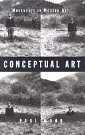
| ISBN: | 9780929445168 |
| Publisher: | Delano Greenridge Editions |
| Published: | 31 January, 2002 |
| Format: | Hardcover |
| Language: | English |
| Links | |
| Editions: |
14 other editions
of this product
|
- 8 Arshile Gorky (Modern Masters)
- 9 Francis Bacon (Modern Masters Series, Vol. 9)
- 10 Hans Hofmann
- 11 Philip Guston
- 12 Constantin Brancusi
- 13 Marc Quinn: Chemical Life Support
- 14 Georges Braque
- 15 Lee Krasner
- 16 Isamu Noguchi,
- 18 Jim Dine
- 19 Max Beckmann
- Modern architecture
- Conceptual Art
- Outsider Art
- Neoclassicism A&I
- Venetian Painting
- Van Gogh
- Modern Sculpture
- Turner
- Rembrandt
- American Art and Architecture (World of Art)
- The Pre-raphaelites
- Mary Cassatt
- Art Since 1960
- World textiles



As befits an art of the mind, 'Conceptual art' poses problems right from the start. What was it? When was it? (Is it still around or is it 'history'?) Where was it? Who made it? (Are we to consider 'X' a Conceptual artist or not?) And of course, the umbrella-question: why? Why produce a form of visual art premised on undercutting the two principal characteristics of art as it has come down to us in Western culture, namely the production of objects to look at, and the act of contemplative looking itself?...These are real questions ... Looked at in one way, Conceptual art gets to be like Lewis Carroll's Cheshire cat, dissolving away until nothing is left but a grin: a handful of works made over a few short years by a small number of artists, the most important of whom soon went on to do other things. Then again, regarded under a different aspect, Conceptual art can seem like nothing less than the hinge around which the past turned into the present: the modernist past of painting as the fine art, the canon from Cezanne to Rothko, versus the postmodernist present where contemporary exhibition spaces are full of anything and everything, from sharks to photographs, piles of rubbish to multi-screen videos -- full, it seems, of everything except modernist painting.